

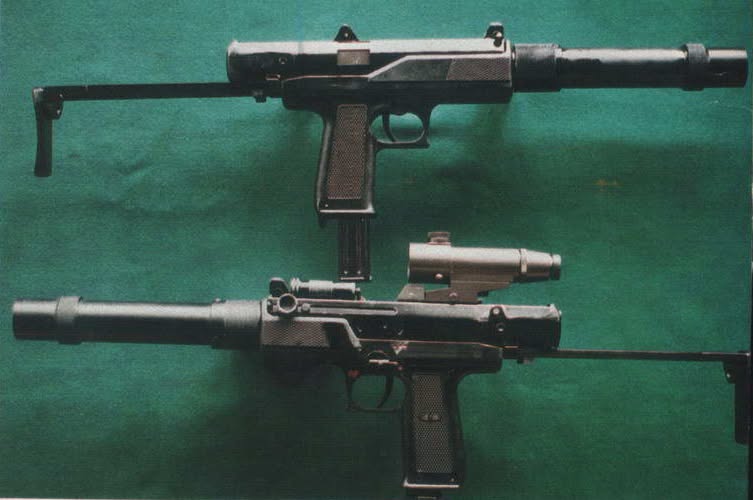
I stumbled across some photos of this gun and did a quick online dig.
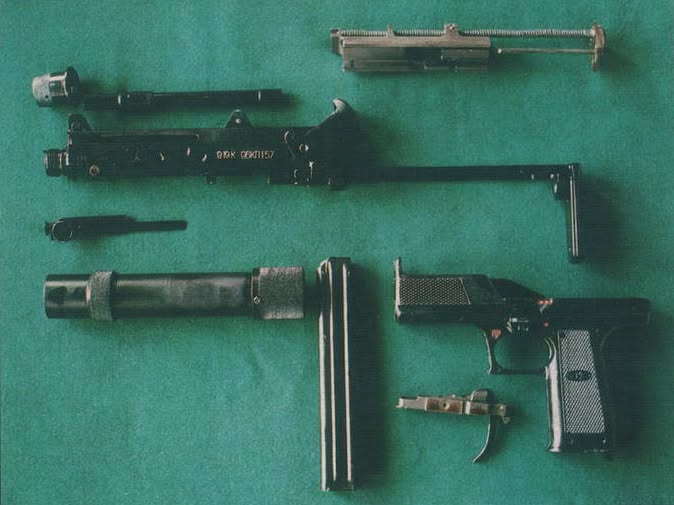
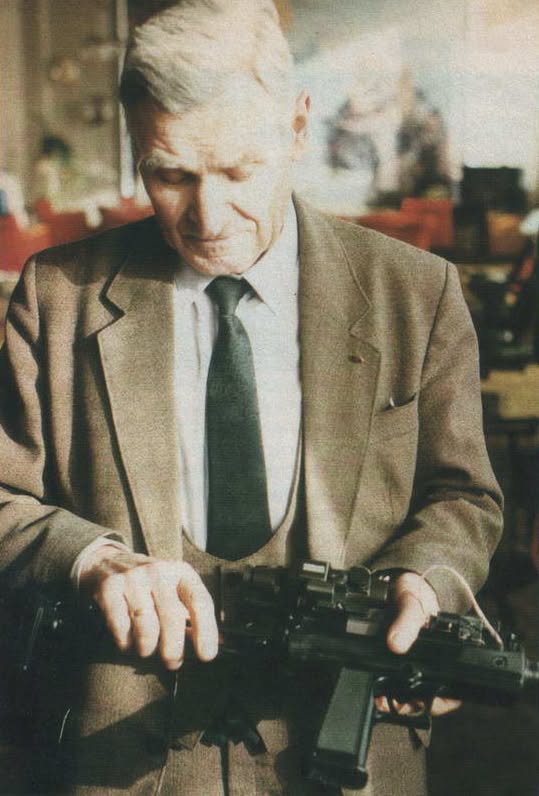
From GlobalMilitary.net:
The AEK-919K Kashtan was developed in 1994 at the Kovrov Mechanical Plant Design Bureau under lead designer Pavel Sedov, scientific supervisor Mikhail Tarasov, and bureau head Stanislav Koksharov. The design was modeled on the Austrian Steyr MPi-69. Following the evaluation of an experimental batch, modifications were made to the initial design to address identified shortcomings, resulting in the AEK-919K. Production at the Kovrov Mechanical Plant ended in 2006 following the liquidation of its special design bureau, though the weapon remained on the Degtyarev Plant product list as of 2013.
The AEK-919K entered service in 1995. Early combat deployment occurred during the First Chechen War with Russian Federal Security Service special forces. In 2002, the weapon was issued to Ka-50 helicopter crews for operations in Chechnya and Dagestan. Official adoption by the Federal Bailiff Service occurred in 2003. Other Russian users include the Ministry of Internal Affairs, Federal Protective Service, and the Federal Penitentiary Service. Internationally, the 25th Special Forces Brigade of Kyrgyzstan employs the weapon. Variants include the original AEK-919 prototype, which featured a square receiver and push-button safety, and the AEK-918 series developed as experimental models for alternative ammunition types.
From TheFirearmBlog:
The AEK-919K Kashtan is a blowback-operated select-fire submachine gun chambered in 9x18mm Makarov. The gun fires from an open bolt, has a telescoped bolt, non-reciprocating charging handle, collapsible stock and built-in drop safety. The rate of fire is 1,000 rpm. This SMG is fed from 20 or 30 round double stack detachable box magazines. The barrel has a polygonal rifling and threaded muzzle to allow attaching a suppressor
How does that work? I found multiple articles that casually say the same thing, but I haven’t been able to find any diagrams or videos explaining it. I thought a fundamental function of a bolt is to be closed, securing the ammunition in the chamber, at the time it is fired.
Open bolt guns are more often dedicated full-auto type weapons. LMGs and Sub-machine guns. This is done to help the weapon cool down and prevent ammo from cooking off in the chamber.
Typically the firing pin is fixed to the bolt and it is designed in such a way that the round doesn’t fire until the bolt is completely in battery.
The bolt remains open until the trigger is pressed. The bolt slams forward, picks up a round from the magazine, and chambers it, firing as soon as the round is chambered.
Most modern SMGs are closed bolt these days, the bolt falling with the trigger doesn’t lend itself to accuracy.
Here’s a video of gun Jesus explaining: https://youtu.be/Ga4uoWmfEt4
basically it means the round isn’t in battery - hasn’t been pushed into the chamber - until the person pulls the trigger. the bolt carrier assembly will then bring the bolt forward, grabbing a round out of the magazine, push it into the chamber and at the very last moment slam a firing pin into the round’s primer. other variants can use a fixed firing pin welded onto the bolt face.
a closed bolt system grabs a round off the mag and slides it into the chamber and locks, often using lugs or some other method to secure the bolt into the chamber/barrel assembly, then, when the user wants to shoot, a hammer or other device whacks a firing pin into the round’s primer.
mostly. there’s a lot of variations on both types.
Ah, that makes sense. Thanks for the explanation. I was only familiar with closed bolt designs.
hope it helps!