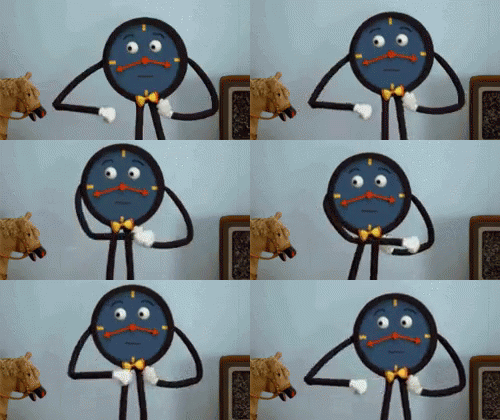
Dr Who?
Jeremy Bearimy.
The dot over the i broke me
Is it supposed to be a heart?
I don’t know what to tell ya.
Kronos the Reaper

Jokes that only work in text.
Edit: Also, I appreciate you @cm0002@infosec.pub - you’re doing the Lord’s work!
Do you pronounce being and being differently?
In isolation, no. But in this meme they are pronounced differently because intonation is different between the two phrases, and as exemplified here: inTOnation is AN inteGRAL part OF lanGUAGE.
“for the time BEing” vs. “for the TIME being”
In both cases you’re stressing the modifier, but in the former “being” is the modifier, while in the latter “time” is, so we get a prosodic stress contrast between the two.
Edit: Note that it’s actually somewhat unexpected to stress adjectives that come before like this (“*I did it for the BIG apple” is weird in a neutral context where you’re not contrasting with a small apple, for example), which makes me think that “TIME being” may actually be an example of compound stress. Here’s a comment I wrote a while back with some more info about English compounds for anyone interested.
Any phonologists that specialize in prosody here who can shed more light on this?
a common thing people with autism and adhd is auditory processing issues, so it could work auditorily for them.
i said it out loud in a few different ways and it sounded the same to me, but it could be a regional thing ¯\_(ツ)_/¯
It’s really interesting that they sound the same to you! I’d expect both to have merged to the “for the TIME being” stress pattern in that case - does that match your intuition?
Interesting, I process time being as a set idiomatic phrase rather than a modifier+ so there’s no need for emphasis on one part or the other. And time being as similar to human being wouldn’t get emphasis unless it was contrasting with a different kind of being. But I also think we’re muddying different types of stress, namely word stress vs prosodic stress. I think your reading has to do with the latter but your example is about the former.
This is a good point worth commenting further on.
Idiomatic phrases usually (but not always) retain a stress pattern that corresponds to the prosody of their original syntax even after they lexicalize. See: “the CAT’s out of the BAG” vs. “the CLAM’S out of the POND” and “kick the BUCKet” vs. “beat the MONkey”.
So, while I agree with you that “time being” (and probably all of “for the time being”, for that matter) is idiomatic, its prosody has fossilized from its original syntax in which “being” modified “time”.
“LET’S put it aSIDE for the time BEing”
“LET’S put it aSIDE for the man EATing”Also, even if the stress has neutralized from “time BEing” to just “time being” over time for some speakers (which is certainly possible), it would still contrast with “TIME being”.
You’re over pronouncing it. You just say it normally and the joke works perfectly fine vocally.
My comment was based on fluent speech, not careful speech.
I’m entertaining the idea that some of the commenters here may speak varieties (or even idiolects) where the two pronunciations have merged, but I think the more likely explanation is that they’re laypeople who (like many native English speakers) aren’t easily able to detect stress contrasts without at least some training.
Anywho, I know who not to tell puns to…
I love puns! I just thought this was a good opportunity to drop some interesting linguistic knowledge about prosody.
This might vary by accent, but the being in the first phase is often pronounced more like one syllable, like “beeng”. In the second phase, I would say the “be” does have stress but less than “time” does.
They are clearly handling sensitive matter that belongs to the Time Being.
Let’s take this offline. Never to be talked about again.
Noone can see the time being. Ask him.
Leave Noh-Wun out of this!
What in the AI is this slop?
What about this seems like AI?