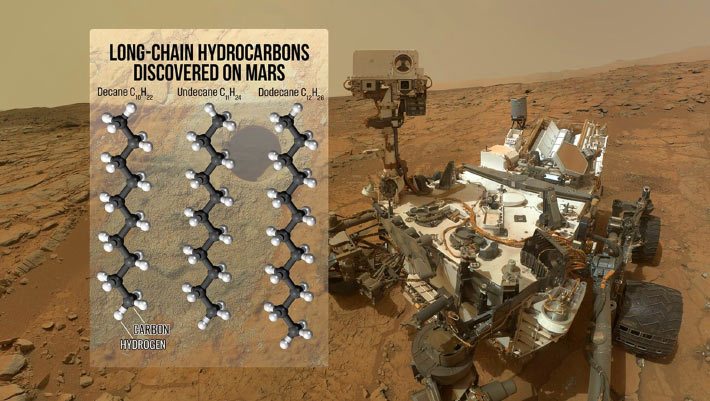
More and more mounting evidence! Exciting times!
Nobody likes the idea of panspermia, the idea that life on earth originated elsewhere in the solar system (or galaxy). It’s unpalatable because it just kicks the can down the road, “if not here, then where did life originate?” “Why not here?” “That doesn’t even answer the question of how life started” and I totally sympathize with all those sentiments.
But we’re finding increasing evidence that life existed on Mars before it existed on Earth. And if that’s true, then it becomes impossible to deny panspermia, because we already know some other key bits of information. First, we know chunks of Marian rock have crashed down onto earth after being ejected into space by asteroid strikes. Secondly, we know that some forms of carbon based life, bacteria and fungal spores can survive both vacuum of spac , extended periods without moisture, and the heat of reentry into atmosphere if they’re embedded into porous rock.
So 1, bits of Mars make it to earth with some regularity. 2, some life will survive a journey to earth. And now 3, there was life on Mars long before it was on Earth.
This unfortunately leaves many questions in its wake… Where did life actually first arise? If it didn’t even start here, then how rare is life? Will we see the same kind of life everywhere we look? (Because apparently everything in the solar system is probably cross pollinated)
Exciting times.
IIRC we don’t know when life started on earth because records of the early earth aren’t available - geological activity recycled the surface. What evidence we do have is that life started pretty much as early as the records we have can show, meaning either it appeared very quickly once the planet cooled or was already present.
It wouldn’t even necessarily need to be life, but the building blocks of life, to make it significant.
A xenonaut sits in a bar with a glass of whiskey in one hand and a cigar in another.
A xenobiologist walks in and sits next to them.
“What was it today? Caustic gas? Acidic rain?”
“A fern.”
The xenobiologist raises an eyebrow surprised by the despair in their tone.
“What’s so bad about a fern?” She asked. “That’s amazing evidence of convergent evolution!”
“Not just any fern. The same fern. Alpha, gamma, delta, epsilon quadrant, all of them have the same genetic blueprint.” He continued putting his cigar out in his drink.
“That’s… amazing! Exciting news even! I mean, celebrate, live a little! You’ve found that the tree of life has roots!” She tried to cheer him up.
“The common… domesticated fern, from here.” He says, getting up and departing, gesturing to the ferns growing on the campus green.
There are MANY steps to prove something this big. You have to gather as much evidence as you can before saying it outright, and that may take decades.
Since https://www.space.com/18758-mars-rover-curiosity-discovery-hype-misunderstanding.html 2012
Not to mention formaldehyde in the atmosphere or the contaminated 1996 meteorites.
NASA has done an amazing job cataloging all of this and the international study of the samples is a herculean effort and enormous accomplishment.
But like, there’s been microbial life on mars in it’s history.
There is sufficient probability of planetary crosscontamination through material transport via impact ejecta, at least in the inner solar system.
This can only mean that we need to expand the search of complex organic molecules elsewhere throughout the solar system. Some of the Jovian moons like Europa or Enceladus seem very promising.
Long chain alkanes? So you’re saying there’s oil on Mars?! Sounds like Mars could use some freedom
Home before Christmas!
Again?
More click-bait. Philosophically speaking, can we ever know anything? Science answers questions based on facts and accumulated knowledge. If either one of those changes radically then the answers may change as well. C’mon…that’s Science 101.
It may not be proof, but it’s evidence. Philosophy isnt science.
I think they were trying to make an epistemological argument, but it was a poorly crafted one and ignores the ground that science has gained over the radical skepticism of a pseudo-Cartesian doubt.
Epistemology does however dovetail with the very foundations of the scientific method, and while “philosophy isn’t science,” science itself is built upon philosophy. That’s why many of the earliest modern scientists were all considered philosophers during their times.
I hear epistemology and all I think of is science deniers, and homeopathic remedies.
And certainly, ones knowledge and understanding of science, especially interplanetary science and the cosmos can alter your philosophical views. But philosophy shouldn’t cloud science.
Then your view of epistemology is skewed by misrepresentations.
Epistemology is the study of knowledge. Traditionally it’s divided into two branches: rationalism and empiricism. Modern science adheres to empiricism, but without some degree of rationalism, pure empiricism would be reduced to a set of facts with no glue to hold them together.
“All apples are fruits but not all fruits are apples” is a rationalist statement because it implies “If it’s an apple, then it’s a fruit” but not “if its a fruit, then its an apple.” It’s grounded on the premise that apples are a type of fruit, which is an empirical fact based on the characteristics of fruits and apples matching that criteria. But the conclusion that the not all fruits are apples is a rationalist deduction.
That’s a simplistic example, and sounds pointless and intuitive, but the same rules apply in more complex scenarios. And if someone is a rational person, then rationalism should sound intuitive. It’s like saying “a triangle’s vertices add up to 180°.” It’s not relative.
Skepticism is different from Epistemology, although there’s some overlap. But there are healthy and unhealthy ways of doing skepticism. Saying “I won’t believe anything without sufficient evidence” is healthy skepticism. Saying “I won’t believe anything ever and I’ll doubt all evidence presented to me” is unhealthy skepticism.
There’s also radical skepticism which asks “Can we ever truly know anything?” It’s about systematically doubting every possible thing, in effect being skeptical of even the human capacity to know anything beyond a doubt. This originated as a neoplatonic school of thought during the hellenistic era, but in modern philosophy it’s more associated with DesCartes’s Meditations and something called Cartesian Doubt, which is more of a thought-experiment rather than an actual claim.
It basically goes “In order to know anything for sure, first we must doubt everything, and then only allow ourselves to believe that which we can know beyond a doubt.” He then presents a rationalist argument to prove that the first thing that he can verify is that he himself does indeed exist, because if he didn’t then he wouldn’t be able to question whether or not he really exists. Thus, the “Cogito Ergo Sum” argument.
Someone who stops reading after the first meditation might think that means he’s a solipsist, but he goes on to later arguments to prove that he can also trust his senses/perceptions to give him satisfactory evidence of objects in his environment.
Bear in mind that he was writing before the scientific method was formalized, and it likely never would have been developed if it weren’t for the way he revolutionized the philosophical tradition. He wrote at just around the cusp between the late-Renaissance and early-Modern eras, and arguably one of the defining features of this era shift is the way in which the philosophical tradition altered course due to the influence od his work. Later thinkers (i.e., during the Enlightenment) built upon his work when they formalized the scientific method.
Even the shift into post-modernism in the mid-twentieth century was due to the influence of a philosopher who framed his work as a radical critique (and divergence from) the work of DesCartes, which wouldn’t have been possible without the advances in philosophy that had taken place over the centuries since DesCartes revolutionized the tradtion. That’s how “dialogue” or “dialectic” works in the history of philosophy: even if you disagree with something and present an entirely new argument as a response, you can’t ignore the influence that the older argument had on the formation of your rejection of it.
But philosophy shouldn’t cloud science.
Good philosophy doesn’t cloud science. If somebody is using bad philosophy, or pseudo-philosophical tautologies, to obfuscate scientific discovery, then what they’re doing is sophism, not philosophy.