You must log in or # to comment.
The conjecture has been checked by computer for all starting values up to 2^71 ≈ 2.36×10^21.
So you’re probably good to go.
This one is easy.
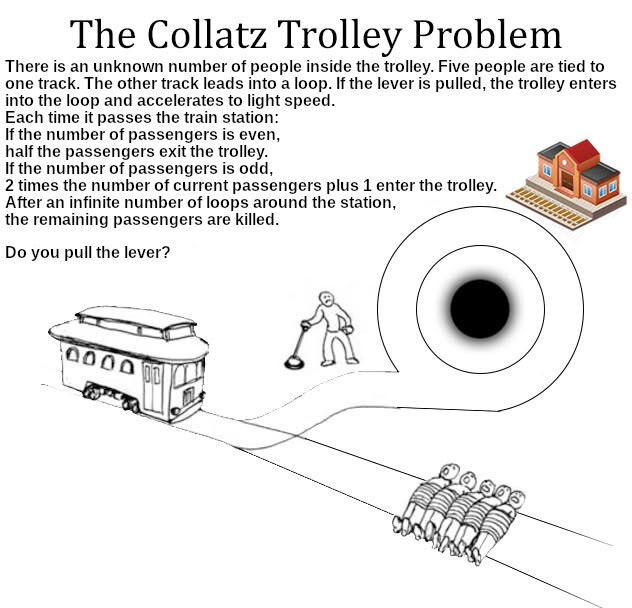
Either you kill 5 people, or you pull the lever and kill none. Because an infinite loop never ends.
All the rest is just fluff with no bearing on the question.
yeah i don’t get what the point is. the answer is easy, you switch tracks unless there is at least one billionaire among the five.
If the trolley is moving at light speed by the time it hits the station, it is impossible for anyone to get on or off because—from the trolley’s perspective—no time passes between stops. Ergo, the number of passengers on it must be the same every stop.
If the initial number of passengers is odd or a non-zero integer, this inability to board/unboard would contradict the rules.
Thus, in order to satisfy all the conditions, the initial number of people on the trolley must be 0. As an even number it will be subject to halving, but 0/2=0, so the rules are satisfied.
Hence, pulling the lever is the optimal solution as 0 people will die. QED.
Also, the trolley going in a loop the speed of light would be immediately deformed and destroyed. If inner points of the trolley go c, then outer points would be going faster, so the tram would forcefully deform. Same with the people inside
Not to be the 🤓 but technically that only applies to Euclidean spacetime. It is possible to have spaces in which loops occur without there being a localized curvature gradient. The manifold might loop but at a small enough scale all manifolds are locally Euclidean. There are also just weird things that happen in hyperbolic geometry where you can have infinite nested concentric circles that are all technically the same size and are centered at infinity (Horocycles).
Anyway, point is that we don’t necessarily know the topology of the space in which the loop resides, so we can’t make the assumption that the trolley would be destroyed.
No, I don’t pull the lever. I don’t want to wait for it to do infinite loops to see the gore and carnage of running over a bunch of people.
Motherfucker here making a math problem for infinite series from a philosophical question. Is nothing sacred /s
After an infinite number of loops?
After an infinite number of loops I’d want to be killed.
After an infinite number of loops are any of the original passengers still on the trolley?
Anything moving at light speed does not experience the passage of time, so yes. Nobody can actually get off the trolley.
Anything moving at light speed does not experience the passage of time
Nobody can actually get off
If time stops for people on the trolley, wouldn’t their subjective experience be of immediately getting off the trolley?
Without solving the collatz conjecture I think you can see it always stays above zero.
Sure, the total number of passengers does, but do any of the original passengers stay on the entire time as new passengers cycle on and off?
i think that can’t really be answered bc there’s no hard rules on who specifically gets off.
if it’s first-on, first-off then all the original riders would cycle out in as little as 2 cycles. but if it’s first-on, LAST-off then at least 1 person from the original bunch would always be on the train.
if it’s random, who knows! someone who took probability and statistics can work that one out lmao
Why does it have to accelerate to the speed of light? I don’t understand what role that part plays in this…
How long does it take to get an infinite number of loops in? Well, it’s going at a finite speed, so it must be an infinite amount of time. Maybe you can argue that at the speed of light causes the inside of the trolley to not experience time past that point, but there’s still all the time spent at sub-light speed accelerating. So at least an astronomical amount of time.
And the rules as stated result in an arbitrarily large number of people on the trolley. So these people after a point aren’t being pulled from Earth, they must be being created wholesale. And then living a life out on the trolley, unless they exit.
So the choices are really 1. Kill 5 people or 2. Create an unknown but large number of people that will live out some sort of lives on the trolley, or get shunted out into the real world, and some smaller but still large number of people that will die prematurely.
I think life is worth living, so I prefer 2
It will always reduce to a cycle of 4→2→1→4→2→1, so you won’t end up with a huge number.
But yeah, it would take infinite time to reach infinite loops, and meanwhile people can get on and off, so in reality nobody dies prematurely…
People can die on the trolley,
Also you’re assuming the collatz conjecture.
If someone dies due to extraneous circumstances, they would die either way so it doesn’t have to factor into your considerations on whether or not to pull the lever.
And while I haven’t done a geometric proof to show that for all odd numbers, it will eventually reduce to one, I’ve worked out the sets for every odd number up to twenty and the pattern holds. While that’s not rigorous enough for a theorem, it’s good enough for me.
I’d be too confused to make a decision
If you choose not to decide, you still have made a choice
Don’t be, that’s falling for their trap!!!
It only accelerates to light speed, therefore it will need infinite time to complete the loops. Thus the risk is not the killing but getting stuck.
If the conjecture holds, naturally there is a small cycle so people can get on and off and use the train as a form of teleporting to the future.
If there are different loops, then still people can take turns.
Even if there are values that diverge, if it can be shown that at least one event of division occurs with a certain average frequency in the infinite divergence, then at any such point all previous guests can exit and the train can be ridden for one such span.
Only if there are no cases of division and endless steps of 3n+1 in the limit, would people be trapped on the train at no subjective time passing, and in essence time travel into the infinitely far future where they are killed.
That’s impossible because if n is an odd number, then 3n+1 is even. The number can never increase twice in a row.
No matter what wouldn’t this grow to infinite passengers? Is that supposed to be the point?
Because any even number is going to halve itself down to
1, which is oddan odd number, then double plus one will always make another odd number so it would grow to infinity.2n+1 enter the trolley, meaning 3n+1, which in the case of n being an odd number, will always equal an even.
It’s stated wrongly. The Collatz Conjecture is about the case where you triple an odd number and add one, that way you enter a loop if you get down to 1 (1 -> 4 -> 2 -> 1)
It isn’t stated wrongly: 2n+1 get on, which means 3n+1 are on board
touche
OH that makes sense, so I misread it.
Passengers: 4 > 2 > 1 > 4
So that’s better, I guess?
Edit: misread the prompt, below original post is wrong, I apologize!
Noe start with three or any odd number :p 3 , 7, 15, 31, 33…
I think only 2^x has the outcome you describe, please correct me if I’m mistaken.
7→22→11→34→17→52→26→13→40→20→10→5→16→8→4→2→1→4→2→1→4→2→1…
Edit: also, 9→28→14→7…
And, 15→46→23→70→35→106→53→160→80→40→20→10→5→16→8→4→2→1…
Or even, 19→58→29→88→44→22→11→…
And lest we forget, 3→10→5→16→8→4→2→1…
That covers every odd number below 20. Want me to do 21 and 25, too? Perhaps 27?
The trick is to read the prompt. I had 2n+1 are the new number of passengers.
Had to reconstruct it from your answer though.
Anyway, thanks!
Odd numbers cause double plus one additional passengers to board. So a cycle starting with 3 is a bit different.
3 -> 10 -> 5 -> 16 -> 8 -> 4 -> 2 -> 1 -> 4 …
Edited my response, I misread it. Thank you!
You misread it, too, did you? 😉
Yes! :/
2n+1 is not in the Collatz conjecture.
Mathematics is not ready for such carelessness.
And I did a dumb. Withdrawn.
Wouldn’t that be 3n + 1? n passengers already present, another 2n + 1 enter, resulting in a total of 3n + 1. Doing it in my head, we seem to always end up in a cycle of 4 -> 2 -> 1 -> 4. All of these are < 5, so once we enter that cycle, the number of possible passengers killed is always less than five.
I am too tired to think too hard about this, so, SURE!
Wouldn’t the tram require all the energy in the universe to accelerate to light speed whilst the object would create a massive wave of radiation and shock waves thus destroying everything in its path?
Thus no more station and peoples on the rail meaning no one can get on or off.
I think everyone inside would die when it accelerated to light speed. And since most numbers are larger than 5 I’d say don’t pull the lever. The only question is what happens to the people inside the trolley if you don’t pull the lever?
It’ll always reduce to a cycle of 4→2→1→4→2→1 etc.
Which means people can get on and off so no one is trapped, and since they don’t die until after an infinite number of stops it means no one will get killed